The Itinerary of the Bordeaux Pilgrim
The Praetorium
Whatever side you're on, Antonia wasn't down in the valley because you accept it was built on a precipitous 50 cubit high rock. (Josephus Wars 5.5.8)
The the centre line of the central valley doesn't intersect the west wall of the temple mount until it reaches the wailing place. (PEF plate 7)
The buildings down in the valley were the Xistus joining to the Sanhedrin Council meeting house before reaching the western cloister of the temple mount. (Josephus Wars 5.4.2)
Ask yourself why Jesus was beaten at the house of Caiaphas by the "great multitude with swords and staves, from the chief priests and elders of the people" (Mt 26:47) instead of the Sanhedrin Council meeting house?
Was it because Pilate had confiscated the Sanhedrin Council meeting house for his own HQ - his praetorium - complete with Xistus?
Read on...
[redacted] relies on the route of the Bordeaux Pilgrim as proof that the house or Praetorium of Pontius Pilate was the Antonia - assuming that the Antonia was the temple mount. That's a rather big house!
"From thence as you go out of the wall of Sion, as you walk towards the gate of Neapolis, towards the right, below in the valley, are walls, where was the house or praetorium of Pontius Pilate. Here our Lord was tried before His passion. On the left hand is the little hill of Golgotha where the Lord was crucified."
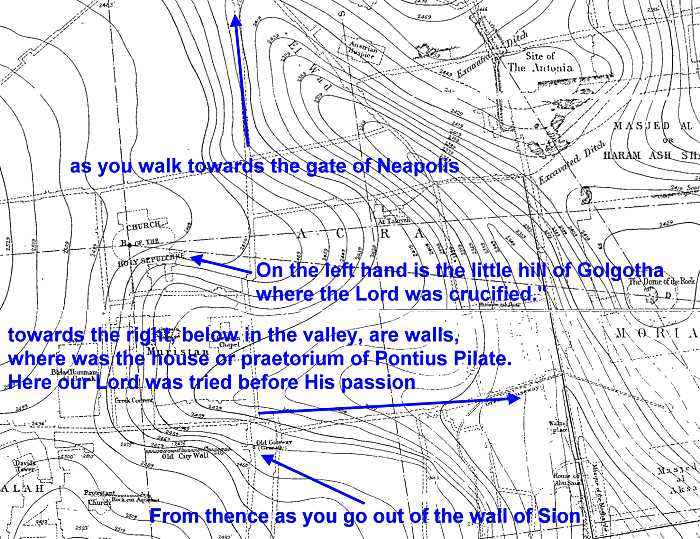
Map comprising PEF plates 2 and 3 joined showing the Sion gate and the road north to Neapolis (Damascus) gate
My source for the Bordeaux Pilgrim Itinerary is "Itinerary from Bordeaux to Jerusalem" translated by Aubrey Stewart, 1887, and I recommend reading Appendix 5.
A point appendix 5 makes is that neither the Antonia or the temple mount are "below in the valley."
On PEF plates 2 and 3, "below in the valley" is indicated by the rock contours, and they're west of the temple mount.
Josephus calls our attention to the buildings west of the temple mount. In Wars book 5, chapter 4, section 2, he wrote:
"Now that wall began on the north, at the tower called "Hippicus," and extended as far as the "Xistus," a place so called, and then, joining to the council-house, ended at the west cloister of the temple."
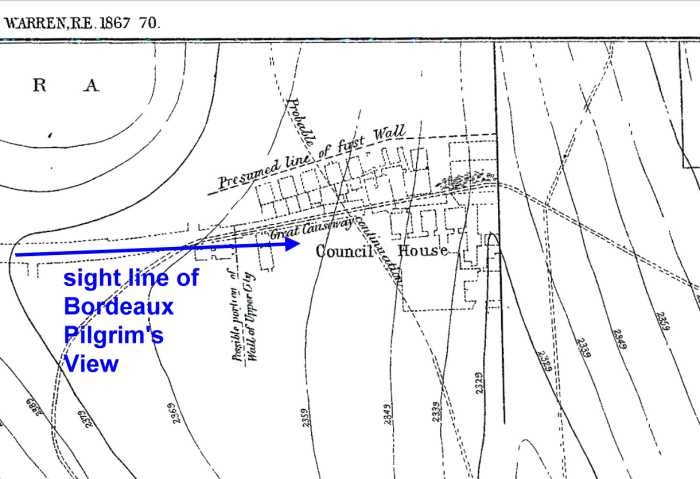
from PEF plate 7 - walls would just be remains
The council-house was the meeting hall of the Sanhedrin (the supreme council and tribunal of the Jews ... headed by a High Priest and having ... criminal jurisdiction) and a Xistus is a long and open portico used especially by ancient Greeks or Romans for exercise (see 1 Macc 1:14).
""Xistus," a place so called," may mean to say it was used for something other than exercise?
There is also the possibility that Pilate had confiscated the council-house for his own HQ - his own praetorium - complete with Xistus?
We also know from the Bordeaux Pilgrim that
"On this side one goes up Sion and sees where the house of Caiaphas the priest was, and there still stands a column against which Christ was beaten with rods,"
So that means Caiaphas the priest was not in the council-house at the time - so Jesus was taken to his palace instead - by?
"a great multitude with swords and staves, from the chief priests and elders of the people." (Mt 26:47)
The Bible corroborates this version of events which can be followed in Matthew 26-27.
"to which the Jews come every year"
After hearing on the DVD that not one Jew was allowed in Jerusalem for a thousand years (hence they forgot where the temple was), it was interesting to read the following from the Bordeaux Pilgrim:
"There are two statues of Hadrian, and not far from the statues there is a perforated stone, to which the Jews come every year and anoint it, bewail themselves with groans, rend their garments, and so depart."
Perhaps that was an accidental error in the DVD?
In another video simply titled "The Temple" by [redacted], [redacted] says the Bordeaux Pilgrim was in the high tower of the Church of the Holy Sepulchre, and he looked east and all he could see was the long wall of a Roman fort.
Sorry, but that's made up! It isn't in the Bordeaux Pilgrim's account at all.
And neither could the Bordeaux Pilgrim be in the high tower. The tower of the Church of the Holy Sepulchre wasn't built until the 12th century AD!
If you want to know my opinion about these false claims, just go to 2 Timothy 3:13!
Here's the full text applicable to Jerusalem, which you can find and read for yourself at
https://dn790009.ca.archive.org/0/items/cu31924028534158/cu31924028534158.pdf
[notes in square brackets are mine]
"There are in Jerusalem two large pools (piscinae) at the side of the temple (ad latus templi), that is, one upon the right hand, and one upon the left, which were made by Solomon ; and further in the city are twin pools (piscinae gemellares), with five porticoes, which are called Bethsaida [Bethesda! North side of the temple mount]. There persons who have been sick for many years are cured ; the pools contain water which is red when it is disturbed. There is also here a crypt, in which Solomon used to torture devils [Zedekiah's cave?]. Here is also the corner of an exceeding high tower, where our Lord ascended and the tempter said to Him, ' If thou be the Son of God, cast thyself down from hence.' And the Lord answered, ' Thou shalt not tempt the Lord thy God, but him only shalt thou serve.' There is a great corner-stone, of which it was said,' The stone which the builders rejected is become the head of the corner.' Under the pinnacle (pinna [fin]) of the tower are many rooms, and here was Solomon's palace. There also is the chamber in which he sate and wrote the (Book of) Wisdom ; this chamber is covered with a single stone. There are also large subterranean reservoirs [cisterns] for water and pools constructed with great labour.
And in the building (in sede) [the site] itself, where stood the temple which Solomon built, they say that the blood of Zacharias which was shed upon the stone pavement before the altar remains to this day. There are also to be seen the marks of the nails in the shoes of the soldiers who slew him, throughout the whole enclosure, so plain that you would think they were impressed upon wax. There are two statues of Hadrian [temple to Jupiter], and not far from the statues there is a perforated stone, to which the Jews come every year and anoint it, bewail themselves with groans, rend their garments, and so depart. There also is the house of Hezekiah King of Judah.
Also as you come out of Jerusalem [the lower city/city of David] to go up Mount Sion [the upper city/"upper market place"], on the left hand, below in the valley [Tyropoean/central valley], beside the wall, is a pool which is called Siloe [Siloam] and has four porticoes; and there is another large pool outside it. This spring [Hezekiah's water course] runs for six days and nights, but on the seventh day, which is the Sabbath, it does not run at all, either by day or by night. On this side one goes up Sion [the upper city/"upper market place"] and sees where the house of Caiaphas the priest was [PEF plate 3 - lower left], and there still stands a column against which Christ was beaten with rods. Within, however, inside the wall of Sion, is seen the place where was David's palace [Herod's palace/Barracks]. Of seven synagogues which once were there one alone remains; the rest are ploughed over and sown upon, as said Isaiah the prophet. From thence as you go out of the wall of Sion, as you walk towards the gate of Neapolis [Damascus gate], towards the right, below in the valley, are walls, where was the house or praetorium of Pontius Pilate. Here our Lord was tried before His passion. On the left hand is the little hill of Golgotha where the Lord was crucified. About a stone's throw from thence is a vault(crypta) wherein His body was laid, and rose again on the third day. There, at present, by the command of the Emperor Constantine, has been built a basilica, that is to say, a church of wondrous beauty [Church of the Holy Sepulchre], having at the side reservoirs (exceptoria) from which water is raised, and a bath behind in which infants are washed (baptized).
Also as one goes from Jesusalem [the lower city/city of David] to the gate which is to the eastward, in order to ascend the Mount of Olives, is the valley called that of Josaphat [Kedron valley]. Towards the left, where are vineyards, is a stone at the place where Judas Iscariot betrayed Christ; on the right is a palm-tree, branches of which the children carried off and strewed in the way when Christ came. Not far from thence, about a stone's-throw, are two notable (monubiles) tombs of wondrous beauty; in the one, which is a true monolith, lies Isaiah the prophet, and in the other Hezekiah, King of the Jews.
From thence you ascend to the Mount of Olives, where before the Passion, the Lord taught His disciples. There by the orders of Constantine a basilica of wondrous beauty has been built. Not far from thence is the little hill which the Lord ascended to pray, when he took Peter and John with Him, and Moses and Elias were beheld. A mile and a half to the eastward is the village (villa) called Bethany. There is a vault (crypta) in which Lazarus, whom the Lord raised, was laid."
End of Bordeaux Pilgrim's evidence.
back to top