Miscellany
(a group or collection of different items; a mixture - almost like a blog)
We Need Every Word of God
(21st August, 2024)
These studies fit into a much bigger picture which is the Bible story itself. In my opinion no part of its story should be changed as it could take away some of the Bible's meaning and the sense it could make of our lives.
Some of this understanding goes back to Noah's curse on his grandson Canaan. Before Israel crossed the Jordan the promised land was partly occupied by Canaanites. Is this why the Jebusites (a Canaanite branch) were "hated of David's soul?" (2 Samuel 5:8)
If we shut off any of the truth the truth becomes distorted. The canon we have today already lacks much of the information needed to comprehend the troubles of this world. It doesn't need changing any further. We need every word of God.
Josephus' Missing Valley
(9th August, 2024)
In the latter half of the 1st century AD, Josephus wrote a description of Jerusalem which is so hard for some readers to understand, and that included me (Josephus, Wars 5, 4.1). A major piece of the jigsaw which makes sense of Josephus' description has only recently been found!
He wrote about Jerusalem as it was during the time of the construction of Herod's temple, which wasn't fully finished until the year 65 AD.
He had knowledge of Jerusalem's "recent history," but perhaps missing some Biblical truth, since he places the Citadel of David on the western hill. This is only reconcilable with the knowledge of Maccabean history.
The peoples of the city of David on the south eastern hill, had been driven out to the Citadel (or Upper Market Place) during the rule of Epiphanes. The true city of David had become a haunt for the heathen.
In that time the temple area (this being the second temple before Herod) had come under Seleucid (Syrian-Greek) control, and was profaned by the sacrifice of unclean meats, namely swine.
The temple and the Ophel area had become a kind of Acropolis of Jerusalem, a temple with a fort. A fort which overlooked Zerubbabel's temple mount from its southern flank. This fort was built on high ground, possibly the hump which is still evident which rises in the centre of the temple mount south wall. The word Ophel meaning hump.
This entire second hill area, described as having "the shape of a moon when she is horned," became known as Acra - Acra being Mount Moriah - the temple mount hill. It "sustains the lower city."
SIDEBAR: Those who have seen [redacted's] video or the book, are shown a crescent moon overlaid on an aerial photo of one bending of the bank above the Kedron valley (the image at the end of this post shows there are plenty of other bends you can fit a crescent moon to).
However, Josephus is describing the lay of the land. It's doubtful he had a drone camera.
Whiston's translation describes the second hill's incline as "the shape of a moon when she is horned." Those being the words Whiston chose to describe the Greek άμφίκυρτος. Άμφίκυρτος meaning concavo-convex, or simply convex, or even gibbous; leaves plenty of scope for misinterpretation.
Thackeray's translation describes it as "a hog's back." Maynard's as "a steep declivity round about it." This Maynard's description removing all chance of ambiguity. So we can see that the "aerial view evidence" is plainly wrong.
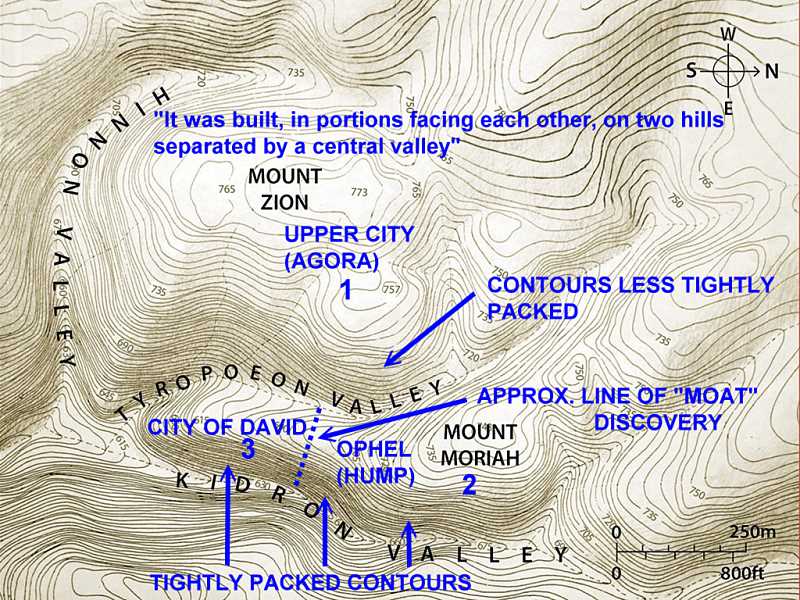
We read "over against this there was a third hill, but naturally lower than Acra, and parted formerly from the other by a broad valley. However, in those times when the Asamoneans reigned, they filled up that valley with earth, and had a mind to join the city to the temple."
If you don't know where that valley was, you'll not comprehend the wording of the description - you won't see the location of that "third hill."
But if you know, then you will know that "third hill" was the original city of David - "...they filled up that valley with earth, and had a mind to join the city to the temple."
Without knowing where that valley was, then it is impossible to comprehend the three hills. You can easily be misled by those who use Josephus' subsequent sentence to say this valley was the Valley of the Cheesemongers:
"Now the Valley of the Cheesemongers, as it was called,..."
That is not the case. Josephus is going on to describe the Valley of the Cheesemongers. He is not saying that the Valley of the Cheesemongers was that former valley, but I guess some jump to erroneous conclusions, plus there seems to be an element of mission creep in Whiston's translation, so it's best to cross reference other translations.
The Valley of the Cheesemongers was not the valley that was filled in. It might have received some part of the height of Acra, but the Valley of the Cheesemongers (the Tyropoean or Central valley) has never been made level. Instead, like most of Jerusalem, it has been built over, changed use, and in recent times near the West Wall, made more level through the demolition of buildings.
It is not filldirt. Another valley was filled-in. But that valley has remained a mystery, until July 2024 - only a few weeks prior to me writing this article.
See Solving mystery, archaeologists find vast moat that protected Jerusalem’s biblical kings
This valley was a manmade (dry) "moat" cut approximately 3000 years ago either by the Jebusites to protect the northern flank of the Jebusite fort - or - cut by king David for the same purpose.
It's location is a little north of the Millo, and that may be the reason for king David building inward from Millo:
"So David dwelt in the fort, and called it the city of David. And David built round about from Millo and inward." (2 Samuel 5:9)
base image courtesy of Free Bible Images
The Sacrificial System
(30th July, 2024)
The sacrificial system was established by the word of God to Moses. It's purpose to atone for sin. In fact, it is recorded in antedeluvian times when Cain chose to ignore its significance.
It is how God ultimately taught mankind right from wrong through His chosen people, the Hebrews. Rather than striking sinners dead (or drowning them in another flood), correction was executed by requiring the loss of property, and in such ancient times, property would be animals bred for food.
It was error correction. A sort of don't do this again or you'll lose yet another animal. It couldn't be any old or sick animal either - only the best without blemish was acceptable. Therefore loss was felt and thus sin was atoned for. Guilt remained but the sin was forgiven.
Jesus was to become the ultimate atonement/sacrifice for sin - available to both Jew and Gentile, and this was symbolised by Abraham's near sacrifice of his only son, Isaac (Genesis 22), replaced at the last moment by a ram.
To believe on and do as Jesus instructed - to repent of sin - to be washed spiritually clean through baptism - to know right from wrong by partaking of His flesh and blood (which will be explained another time).
God chose the place for His people, Israel, to be summoned to sacrifice and make offerings in atonement for their sins. That place being the Holy Mountain of God; Mount Moriah.
Be aware that God chose the Holy Mountain of God, not some sensationalist after his own fame. The Bible is clear in verse after verse and chapter after chapter regarding that mountain's location.
The Evidence in The Bible page offers multiple proofs, but not every single chapter and verse. The following is not there, but it is here now:
"In the second year of Darius the king, in the sixth month, in the first day of the month, came the word of the LORD by Haggai the prophet unto Zerubbabel the son of Shealtiel, governor of Judah, and to Joshua the son of Josedech, the high priest, saying," (Haggai 1:1)
"Thus saith the LORD of hosts; Consider your ways. Go up to the mountain, and bring wood, and build the house; and I will take pleasure in it, and I will be glorified, saith the LORD." (Haggai 1:7-8)
Haggai also prophecied its Herodian expansion:
"The glory of this latter house shall be greater than of the former, saith the LORD of hosts: and in this place will I give peace, saith the LORD of hosts." (Haggai 2:9)
Gratitude to the Jewrnal video in my earlier post for calling my attention to Haggai.
HERE
(28 July, 2024)
Here is what makes the difference - the word "here;"
If Jesus and the twelve were sat on the mount of Olives, the word used would have been there - over there.
And not "...Master, see what manner of stones and what buildings are here!" (Mark 13:1)
Surely it would have had to be: Master, see what manner of stones and what buildings are there!
Or, Master, see what manner of stones and what buildings are over there!
However, the word used is here. We can also read "...verily I say unto you, There shall not be left here one stone upon another, that shall not be thrown down." (Matt. 24:1-2)
So that's in duplicate.
In Luke 21 it's different. The word here isn't used because it isn't required, and it isn't required because it directly follows the poor widow casting all she had into the treasury - the treasury being on the temple mount;
"...but she of her penury hath cast in all the living that she had. And as some spake of the temple, how it was adorned with goodly stones and gifts..."
So, that sets the scene which should be easy to grasp.
You see, there are those who accuse people like me of twisting the words of Jesus to make people believe the temple was on the temple mount... (think about that!).
And that might sound confusing to those who don't understand what this web study is about, but those people say the temple was never on the temple mount. So who is actually twisting words?
Therefore, to prove their point, this entire discussion between Jesus and the twelve has to happen on the mount of Olives, such that the entire temple complete with its foundations has to disappear. Because that's proof that the temple was not on the temple mount - that it was somewhere else - because all traces are gone.
Perhaps they never studied the actual words?
God would know these people were going to pressure members of their church into believing what they were going to say. Therefore, He included the word "here."
But there's another way to get the context even without the word "here," and that is to read the previous chapters to Mark 13 and Matthew 24. The setting is inside the temple - inside the temple buildings - inside its meeting rooms, which "...Jesus went out, and departed from the temple..." (Matt. 24:1)
All these buildings stood on a massive platform - the temple mount - which he had not yet left, and where He spoke the prophecy about the destruction of the temple.
What Jesus spoke did happen. It came to pass in 70AD. The proof has been found, and that's important because otherwise "scoffers" will continue trashing the Bible - as they do - saying it's a made up story. We don't need a fake story like this to aid and abet the "scoffers" any further!
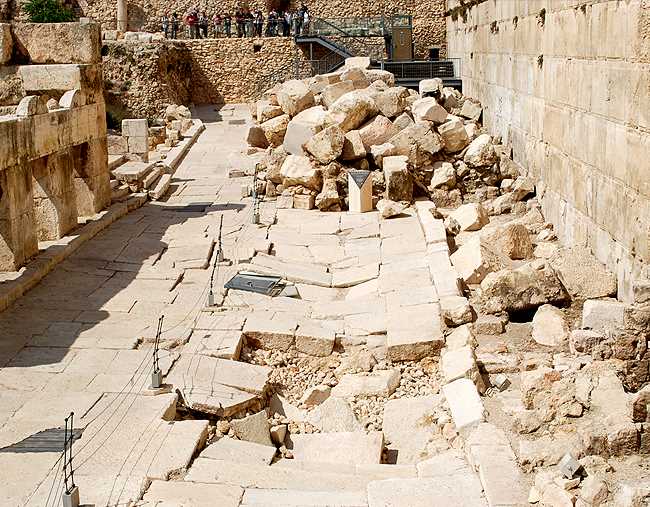
"...The temple, how it was adorned with goodly stones and gifts..." all got thrown down off the temple mount, and a good deal of the upper retaining walls of the temple mount too. They've been found - not all of them neatly in a pile - many were reused in other buildings, and in repurposing the temple mount numerous times, as it has been since those days. As for the rest see the image:
(photo found online)
Jerusalem built over them. The stones are beneath the temple mount perimeter. The whole lot cannot be dug up, but if it were to be, all those stones Jesus prophesied would be revealed.
So, if the temple was supposedly in the city of David, where are all those Herodian stones?
There are none. The area where it was supposed to have been has been dug and no trace found. Instead, plenty of evidence of what actually stood in the city of David.
No, the Biblical texts were cherry picked by a church that condemns cherry pickers.
For more stones watch this video:
A Different Slant To The Antonia
(11th July, 2024)
"It was built upon a rock fifty cubits high and on all sides precipitous." (Wars 5.5.8)
On its north-north-west and south-south-east sides there were excavated ditches, but to the west-south-west and east-north-east sides the rock contours show natural gradients of between 40% and 67% (21 - 33 degrees), and over a distance of 100 to 200 yards/metres.
30 degrees is hard to walk up or down even for a short interval, and so these distances would be very tiring for an invader to charge at.
If the Antonia was square as Josephus says, then to cover the rocky outcrop area it would overlap the excavated ditches, or otherwise it would have to be at an angle to the temple mount, for these to be precipitous on all sides.
I guess it didn't have to be parallel with the temple mount?
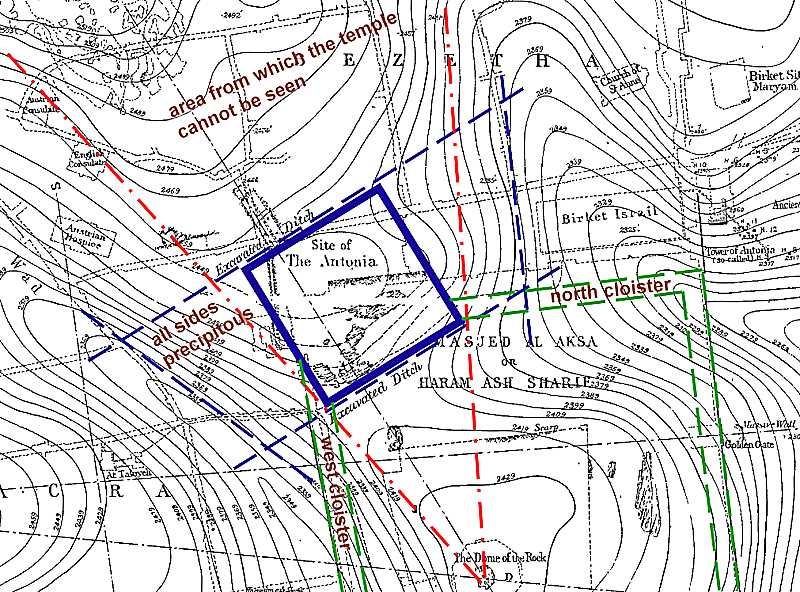
I'm sure there are problems with this idea, but with not even a sketch from that time in history, conjecture is all we can do.
Scarped
(10th July, 2024)
Scarped is an interesting word that I'd not been familiar with before undertaking this study. But as the word scarped is seen on some of the PEF plates, and near to the 'subject of contention' (the Barris that became the Antonia), I thought I'd better get educated.
A scarp is something that is cut into rock on purpose, or has eroded that way. The foundation of the Barris looks to be a combination of the two. East and west were branches of the Tyropoean and Kedron valleys, and north and south we see rock cut ditches and scarped rock.
While doing the Evidence of Josephus page - the section entitled "The 50 cubit rock," I'd partly grasped that the Barris could have been between the two excavated ditches (PEF plates 2 and 37), and was struggling with the rising north-west corner of today's temple mount.
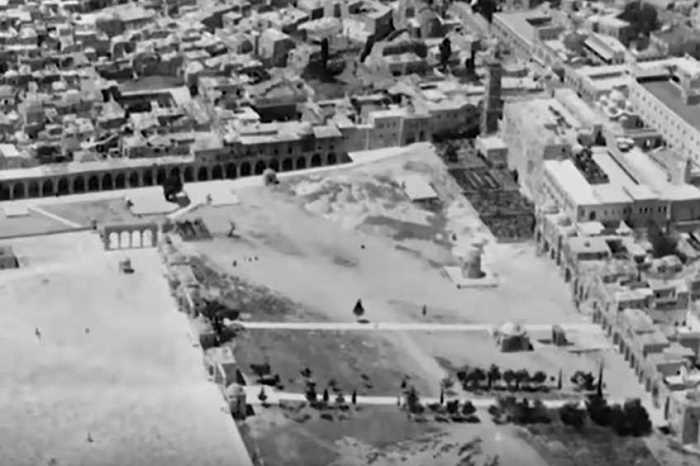
The raging argument has always been about the size of the so-called Antonia seen today, and I had this mental picture that it could have been considerably larger. It was, after all, present before the Herodian expansion, and we know this from the Maccabean history in the Apocrypha, as well as the explanations by Josephus.
Ambiguity is the biggest enemy of facts, and Josephus doesn't give us a clear cut location picture. He probably didn't think that in the future there would be a full-scale war in the churches over his words. All he says is
"Now as to the tower of Antonia, it was situated at the corner of two cloisters of the court of the temple; of that on the west, and that on the north;" (Wars book 5, ch.5, para.8)
Now, are we sure we know where those two cloisters were? Are they still there today? Obviously not. As Jesus said about all the buildings you see HERE - here on the temple mount - not one stone shall be found upon another (paraphrased).
The whole lot of what can be seen up on the temple mount today was the work of the Umayyad Caliphate. And if you don't think they were capable of so much reconstruction, just think of what the more recent IS Caliphate destroyed!
So perhaps the Umayyad Caliphate scarped off half of the 50 cubit high rock on which Antonia stood. If so, they didn't flatten it fully as can be seen by the rising north-west corner.
However, according to Josephus, the Jews did it:
"for the Jews, by demolishing the tower of Antonia, had made their temple four-square," (Wars book 6, ch.5, para.4)
Either way, the evidence for the location of the Antonia (the Barris Herod repaired) is between the two excavated ditches that, with the 'help' of the upper Tyropoean and Kedron valley spurs, made a 50 cubit high precipitous rock.
And the evidence of the Antonia being square:
"Now on the north side [of the temple] was built a citadel, whose walls were square," (Antiquities book 15, ch.11, para.4)
As for the 'squareness' which can now be seen, perhaps they were unaware of the 3-4-5 rule.
Ezekiel's vision of a Temple
(9th July, 2024)
Because this is a prophetic vision I did not include it in The Evidence in The Bible.
Some say that Ezekiel's temple vision is the basis of what it says in the book of Revelation. However, Ezekiel was the prophet of the Babylonian captivity, and his vision must have greatly aided Zerubbabel.
"Now when he had made an end of measuring the inner house, he brought me forth toward the gate whose prospect is toward the east, and measured it round about.
He measured it by the four sides: it had a wall round about, five hundred reeds long, and five hundred broad, to make a separation between the sanctuary and the profane place." (Ezekiel 42: 15 & 20)
And we find today the "ashlar stones" thought to be of the walls of the Zerubbabel temple mount or foundations (as featured in a number of YouTube videos) at the base of the dome of the rock north-west platform steps.
If you set a square to that corner and enlarge it to the eastern wall of the temple mount, it should measure 850ft x 850ft, or thereabouts. In cubits that's 500 x 500, which suggests the "reed" was a "cubit rod."
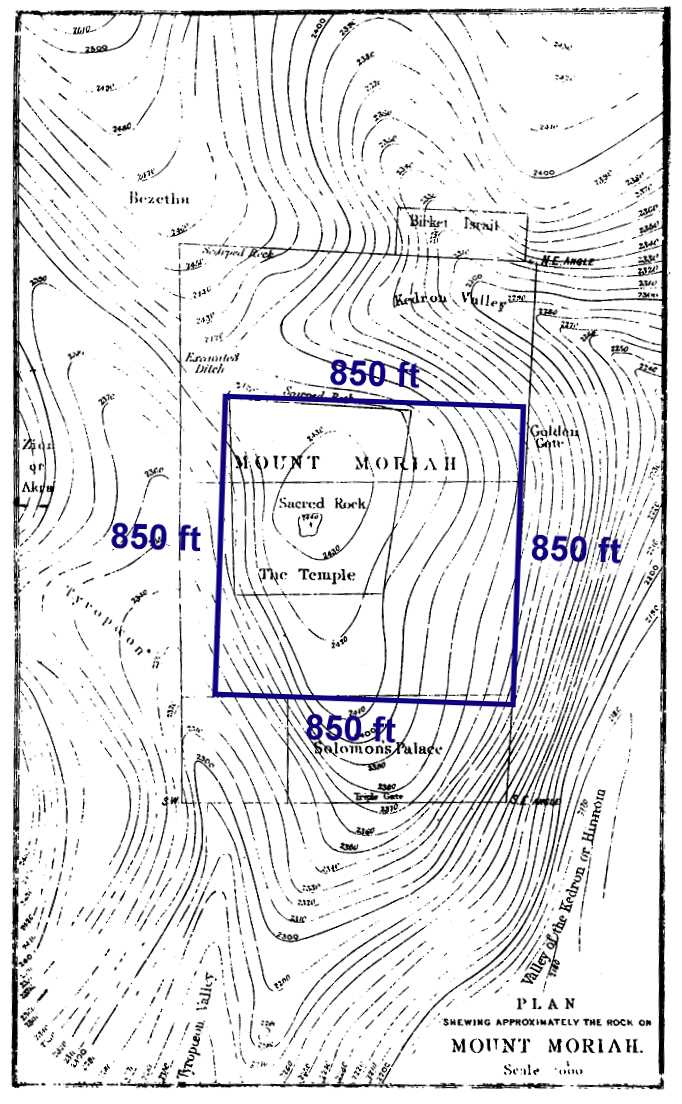
The eastern wall was the furthest east it would go before falling into the Kedron valley, and that wall has remained to this day as part of the much enlarged Herodian temple mount.
There is an excavated ditch just to its north-west angle joining the Tyropoean and Kedron valleys for its defence, and a further excavated ditch just below the "new town" of Bezetha.
Josephus and 1 Maccabees tells us the Maccabean family built a Barris at the north-west angle, and Josephus tells us it was named the Antonia by Herod after he repaired it.
Temple etiquette required that "he shall not return by the way of the gate whereby he came in" (Ezekiel 46:9), and so some of the gates were (at least) double - an entry and an exit in one.
Perhaps the connection to the Barris had these same rules, and requiring some sort of bridge over the excavated ditch, it might have had an entry bridge and an exit bridge side by side. I once saw a PEF drawing suggesting such.
At the time of Herod's expansion it seems this ditch had been filled as part of the expansion of the outer court, with entry and exit points to the north and west cloisters which adjoined the Antonia.
Christian Hate
(earlier post)
I was shocked. I mean, I knew Jesus had come to set people against each other, while at the same time being nice to each other, but hate on the scale of a virtual stoning!?
A growing group believes a particular thing and woe betide you if you don't agree. You must fall into line.
This isn't Waco. The National Guard aren't being shot dead on the roof. No, it's simply hate. Or is it just spirited debate? "Lies, lies, lies!" and "bullsh*t!" are cries of hate, not debate.
It's the inability to way up evidence, and it results in division. It's Sola scriptura with a twist. Get a 99% score in righteousness then drop the bombshell.
It's called gaslighting, and I should know. I've been gaslighted most of my life. Recognising it isn't instant, no matter how much experience you have of it. It takes time to realise. Little hints of doctrine are dropped here and there - in fact, the Bible spills the beans on the technique (Isaiah 28:10): drip, drip.
A lesson from Paul about being stirred up:
"And the brethren immediately sent away Paul and Silas by night unto Berea: who coming thither went into the synagogue of the Jews. These were more noble than those in Thessalonica, in that they received the word with all readiness of mind, and searched the scriptures daily, whether those things were so. Therefore many of them believed; also of honourable women which were Greeks, and of men, not a few. But when the Jews of Thessalonica had knowledge that the word of God was preached of Paul at Berea, they came thither also, and stirred up the people." (Acts 17:10-13)
Ain't that so?
Hastening the Messiah
The Rebbe met a young Netanyahu at the UN in New York. They met again a number of times. The Rebbe told him to hasten the Messiah and build the third temple: "the Messiah must come!"
The Messiah will come. However, he'll come when God decides, and no man can influence God. But what about Jesus? He was a man who influenced God to do things like healing. No, Jesus said "I AM." Let's get it right. Jesus was God in the flesh - not a man made from sexual intercourse, but one made by the holy spirit - the only one ever.
The book of Job should inform the "Christian" that he or she has no hold over God. Netanyahu isn't a Christian, as far as I can tell. The Jewish religion only has the five books of the law - it doesn't get as far as the book of Job, or the Prophets, nor the chronology that precious-few Christians study!
The Samaritans
A tribe from Samaria consisting of Israelites but under the control of its invaders since the latter Assyrian empire.
Samaritans are thought of as being "good." That wasn't the case. There was a good Samaritian - the woman at the well who talked with Jesus then spread the word.
Historians take the view that not one Israelite existed after the northern ten tribes were invaded by the Neo-Assyrian Empire. Samaria was annexed by them - it doesn't say that every single Israelite, man woman and child were put to death.
At the time of Jesus there was still the hatred that had existed between the northern ten tribes under Jeroboam and the tribes of Judah and Benjamin under Rehoboam.
So, perhaps the Assyrians came back a few centuries after their own "extinction event" to rid the planet of the ten tribes? That would have had to be a while after Jesus met with them, eh? (chronology again!)
No, it's just politics designed to suit an agenda. Who's agenda?
back to top